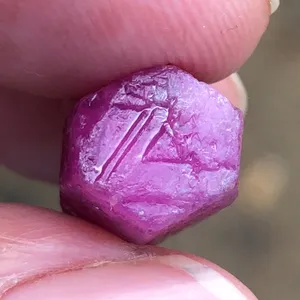
A few days ago, we had the opportunity to buy one of the world’s rarest gemstones, known as serendibite, from a street market in Ratnapura, Sri Lanka.
Because of its rarity, we decided to show the stone to a well-known gemstone dealer and collector in Ratnapura, often called the “City of Gems.” After examining the stone, he asked us to wait for a few minutes. He then opened his highly secured gemstone collection locker and brought out a rough serendibite specimen.
The stone weighed 6.32 carats and was a transparent greenish-blue rough crystal. It had been certified by GIA (Gemological Institute of America) in 2012 as serendibite.
He shared an interesting story about the stone. According to him, a buyer from the United States had offered 100 million Sri Lankan Rupees (LKR) for it back in 2012. However, the shareholders at the time believed the stone was worth even more and decided not to sell it. Unfortunately, that offer never came again.
What Is Serendibite?
Serendibite is one of the rarest gemstones on Earth. Its name comes from Serendib, the ancient Arabic name for Sri Lanka, where the mineral was first scientifically described in 1902.
It belongs to the sorosilicate mineral group and has a complex chemical composition containing calcium, magnesium, aluminium, boron, silicon, and oxygen. These elements must come together under very specific geological conditions, making natural serendibite extremely rare.
In appearance, serendibite can range from pale blue-grey to nearly black. Fine gem-quality specimens may display subtle blue or green tones under certain lighting conditions. The gemstone has a refractive index of approximately 1.701–1.706 and a specific gravity of around 3.42–3.52, both of which are important characteristics used in gem identification.
Serendibite has a hardness of about 6.5 to 7 on the Mohs scale, making it reasonably durable for a gemstone.
Gem-quality serendibite has been found in only a few locations worldwide, with the most notable sources being Sri Lanka and Myanmar. This exceptional scarcity has contributed greatly to its reputation as one of the world’s rarest gemstones.
Myth vs Reality
If you search for serendibite online, you may come across claims that it is worth millions of dollars per carat. In reality, many of these figures are outdated, exaggerated, or based on isolated reports rather than actual market transactions.
The truth is that rarity alone does not determine value — demand is equally important. While serendibite is extraordinarily rare, it does not have the widespread recognition, established collector market, or consistent demand enjoyed by gemstones such as alexandrite or Padparadscha sapphire.
Over the years, many owners of serendibite have held their stones for long periods without finding a serious buyer. This highlights an important lesson in the gemstone trade: even the rarest gemstone may have limited value if there is little market demand.
We acquired this stone at a modest price, and it will remain part of my collection. Rather than viewing it as an investment, I see it as a fascinating piece of gemstone history and a reminder of the excitement that comes with discovering something truly rare.